

History tends to get squashed; it’s something I find repeatedly in my interviews. Take Silence = Death as an example. It’s the defining image of ACT UP and the AIDS crisis, but its existence actually predates ACT UP. It was created months before the group formed.
That’s something that I didn’t know before talking to Avram Finkelstein.
After Avram lost his partner in 1984, in the early days of the epidemic, he started having weekly dinners with Brian Howard, Oliver Johnston, Charles Kreloff, Chris Lione, and Jorge Socárras. “ We needed a place to consider what being gay in the age of AIDS meant,” Avram told me. “ And we would spend pretty much the first part of the evening talking about fears with sex. We were afraid we’re going to die alone. We were afraid we were going to die…and we would end up talking about the politics of aids. There were AIDS service organizations, but there was no political organizing.”
Ultimately Avram introduced the idea of creating a poster to go up around New York City and after months of brainstorming the group landed on the image that you’ve seen countless times before:
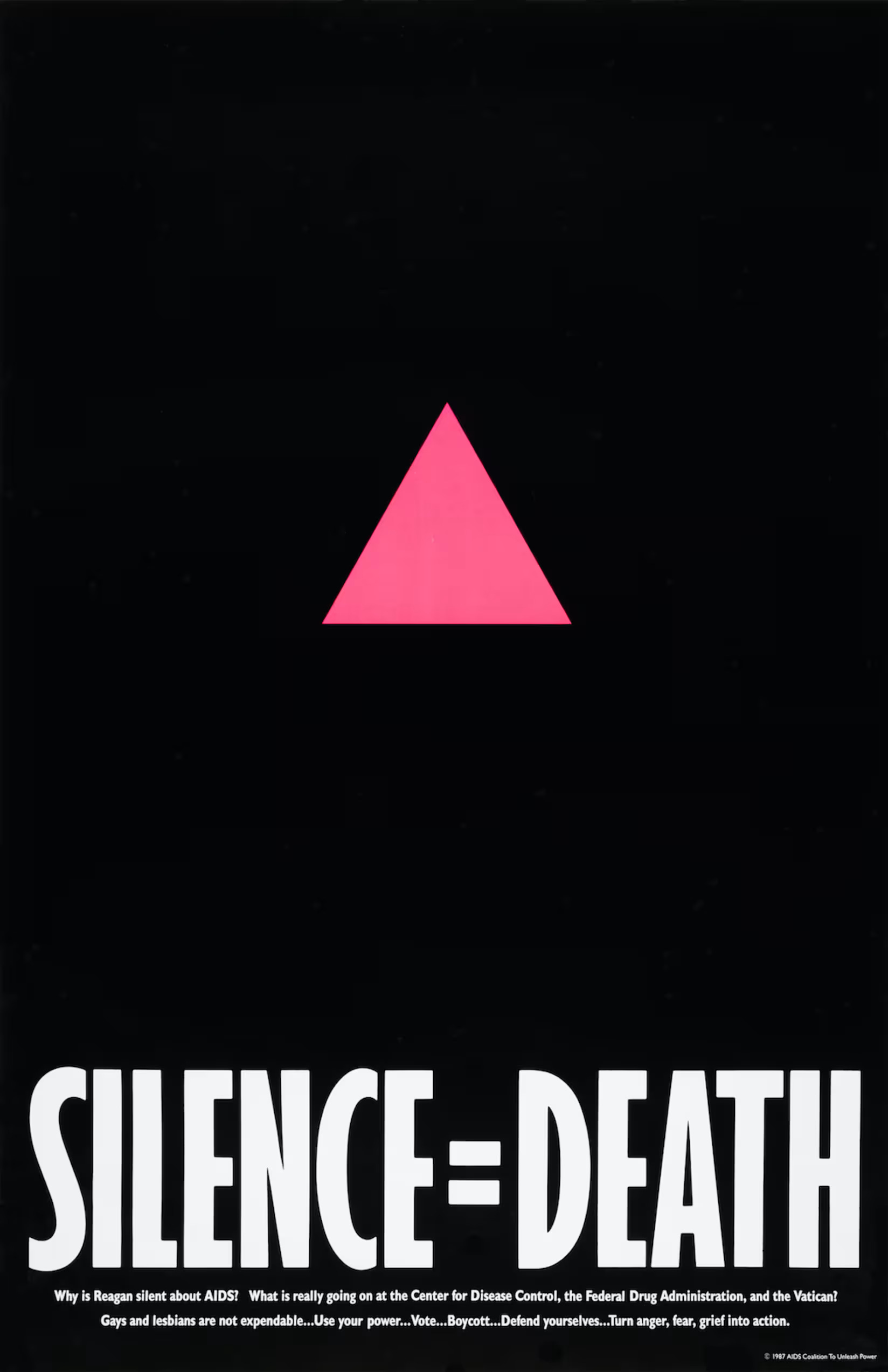
The small text at the bottom reads:
Why is Reagan silent about AIDS? What is really going on at the CDC, the FDA, and the Vatican? Gays and lesbians are not expendable…Use your power… Vote…Boycott…Defend yourselves…Turn anger, fear, grief into action.
It’s one of the most recognizable and influential works of protest art in history.
Avram joined ACT UP at its first meeting and eventually helped form its artist collective, Gran Fury, which is responsible for creating much of the visual language of the AIDS crisis. We spoke at his home in Brooklyn, NY.
This interview has been edited and condensed.
JM: I want to begin in the ’80s. I know your partner Don got sick in the early days of the crisis. Was it ’81 when he started showing symptoms?
AF: I think ’80, but I think actually 1979 is probably more accurate. I say 1980 because that’s when my mother acknowledged, or saw, that he was immunocompromised.
JM: I feel like when we tell the story of the AIDS crisis, we typically start with the formation of ACT UP because it’s just a bit easier to say things were bad and then we responded. ACT UP began in 1987. Your partner’s sick in ’79, ’80…
AF: He dies in ’84.
JM: And so, in the pre-ACT UP era, how were you thinking about AIDS?
AF: I mean, I think the thing is, nobody knew how to talk about it, when to talk about it, or wanted to talk about it. And there were all of these kind of coy codes for talking about it. “You don’t look well, did you lose weight?” Those were the kinds of questions people would ask instead of “Are you sick?” Or if somebody was dying, people would say, “Oh, I hear he’s not well,” or “I hear he’s sick,” but they wouldn’t say what with. I think there was a high level of ignorance, but there was also a social ineptitude. And it’s weird to think that in Manhattan, in art and music and fashion circles — of all the people in the world you would think would be equipped to actually have a conversation.
After Don died, one of my closest friends, Lori Goldstein, took me to dinner. I was like a Greek epic — theater rage and despair — and I could see her rearing back in her chair. It was the last time I ever saw her or spoke to her. It was too much. It was just a complicated moment, and nobody knew what an appropriate response — personally, politically, socially — might be.
I think there are many things that we don’t talk about. Queerness was one of them. AIDS was one of them. And I think in certain circles, people still don’t talk about AIDS, or know anything about AIDS, or know the history of AIDS.
JM: Well, as you said, Don died in 1984, and you describe not his death, but specifically his parents’ response to his death, as what politicized you as a gay man. Will you explain what happened?
AF: Well, I think what I said was it connected my politics to my being gay. I don’t think my parents responded any more appropriately than Don’s parents did. But up until the point when Don got sick — and I think this is what happened with both of our families — my mother thought that Don was going to infect me, or that I was infected. And Don’s parents thought I had given Don AIDS. They didn’t know that Don used to have sex with people in New York subway bathrooms — there used to be bathrooms in subway stations in New York. So they couldn’t cognate it. They were perfectly comfortable and adoring of Don being gay, and adoring of me being his partner. We were inseparable, and I spent a lot of time with his family.
Shortly, literally days after Don died, they came to my apartment to collect everything that was Don’s: his masters for his recordings that they didn’t have, other ephemera, things I had given Don. There was a sweater I bought — a four-ply cashmere sweater, really, really warm. Don was always cold and always wore it, and his sister thought it was his and took it.
JM: And this is without your consent, that—
AF: There was a spiral staircase. I was on the staircase in tears the entire time as his two brothers, and I think one of his sisters, and his two parents literally ransacked my apartment. I was there with Chris Leone from the Silence = Death Collective, who I’d met through Don. Chris knew they were coming and wanted to prevent them from doing what they ended up doing, but he was mostly consoling me. It was literally like locusts sweeping across Savannah. They were in and out in half an hour, and it was done. It was horrible. It was really horrible.
JM: Wow. And so after he died, you formed the collective that became Silence = Death. And the poster came out of that. However, that was not the initial purpose of the group. What did you guys initially begin meeting for?
AF: So Jorge, who I had known for several years, came to me after Don died and invited me to dinner, and brought Oliver Johnston, who I did not know, with him. The three of us were having dinner and talking about other people we knew. At a certain point, we decided that we needed a place to consider what being gay in the age of AIDS meant — that was the phrase we actually used. And I said I think we should form a consciousness-raising group, because I come from a political family and knew women in the feminist movement who were in consciousness-raising groups. I knew how they functioned and what they were for.
So I suggested we form a consciousness-raising group, and I said, in order for us to have a challenging or productive conversation, it shouldn’t all be people that we know. So each of us should invite one person the other two don’t know. I invited Chris Leoni, Oliver invited Charles Kreloff, and Jorge invited Brian Howard — and that was the collective. We met every week at a different person’s apartment, and we would spend pretty much the entire first part of the evening talking about fears with sex. We were afraid we were going to die alone. We were afraid we were going to die. We didn’t know how to talk about it with anyone. We would frequently bring in clippings to help orient what the topics might be. And during the tail end of the evening, we would end up talking about the politics of AIDS.
There wasn’t really any place in New York. There were tons of AIDS service organizations, everyone knew the ones that existed — but there was no political organizing. Because of my experience with postering, after the May ’68 student strikes in France, but also throughout the student mobilization against the war in Vietnam, I was very aware of the use of posters. In fact, that’s how people communicated when I was a teenager. We used the streets. So it became obvious to me there was something missing. There was no public conversation about the politics of AIDS. So I thought, well, let’s just make a poster. Let’s make a fucking poster and see if it leads anywhere.
JM: I mean, one of the themes of this conversation has been talking about AIDS with coded language, this silence, and of course, Silence = Death. But how did that phrase come up in the meeting itself?
AF: I ran across a very trite phrase — it’s trite now, and was probably trite then — in a New York Times article. It wasn’t about AIDS, it was about something else, about silence being deafening. I had written it in my journal. At the final meeting of 1986, where we decided what the poster was going to be — we didn’t work on the poster every meeting for the entire year, but pretty much for nine months, I’d say, we worked on the poster at some point during the meeting — we were tossing around ideas, and argued about it, and thought about it, and had ideas and discarded them.
This meeting was at Jorge’s. His apartment was on Fifth Street, right off Avenue A. We were talking about the poster, and I mentioned. I read out of my journal, “I saw this thing in the Times, I’m not sure about it, but it kind of struck a chord for me: the silence is deafening.” And someone else — the volley literally lasted as quickly as I’m saying it to you now — someone said, “Oh no, it should be silence is death.” And then someone else said, “No, it should be silence equals death.” And then someone immediately after that said, “Oh no, it should be an equal sign.” And we all screamed, because we had decided we were going to use a pink triangle, but we didn’t have the tagline. And whenever you have a poster on the streets of New York, in particular, you’re in contested space. There’s lots of other visual information, so you need something to draw you into the poster. That’s what we were missing, and that line came out of this fifteen-to-twenty-second volley.
JM: What did it feel like to see the poster up for the first time?
AF: I don’t think I paid close attention to that question. I was more concerned with whether it was efficacious. My mother came to visit me on 42nd Street and passed by one of the posters we had put up. She didn’t know I had done it. When we were talking about it and I told her, she said — my mother was a Marxist, given to hyperbole, I wouldn’t say melodramatic, but — she said, “I saw it and I thought it’s like the shot heard round the world.” I think that was the first time I paid attention to its impact, because there was no way to gauge its impact.
JM: That’s very encouraging.
AF: Yeah, well, if one relies on their parents for approbation. But I was raised to be independent, although I had tremendous respect for my mother, so her saying that seemed hyperbolic. But yes, it was encouraging.
JM: And so soon after that, ACT UP forms, you’re there at the first meeting. What was it like to go from working in a group of six people to a group of like 300?
AF: Well, it wasn’t 300 until after the first Pride march that summer.
JM: Oh, I thought 300 were at the first meeting. How many were at the first meeting?
AF: A hundred, on a good night. I didn’t find out until having a subsequent conversation with somebody that Larry had actually called a whole bunch of people to come to that meeting. I did not know that. So there were a certain amount of people who were there because of Larry, and I brought the Silence = Death Collective to that meeting. That was the meeting at which ACT UP being formed was just suggested.
So I said to the collective, instead of dinner at someone’s house, let’s meet and hear Larry talk, ’cause Larry was the only one talking about the politics of AIDS. I said, maybe he’ll say something like, we should do this. And it was at that meeting that it was decided we would meet later that week — that was the formation of ACT UP. I have notes from that very first meeting, and I think what’s noteworthy about that conversation was: Larry did his didactic thing, like, “You’re all fucked up, we’re all gonna die, you’re gonna be to blame.” He made half the room stand up, and then he was like, “You’ll all be dead.” And then, “What are we going to do about it?” I think he’d given that talk many times and was accustomed to no one responding. But people were jumping out of their chairs — hands shot up everywhere. I took notes on the things people were suggesting we do, and they were: block every bridge and tunnel, boycott, stop the New York Times trucks from leaving the bays, demonstrate at the Food and Drug Administration — like, everything ACT UP went on to do was suggested by a room full of strangers on that first night.
I don’t think Larry was prepared for that response. And I think when people, in hindsight, think about the AIDS crisis and AIDS activism, they think of it like this lightning bolt from the sky. It was a slow-motion train wreck. It was years of people hiding and whispering and not knowing what to do, working at service organizations. It was inevitable that something would trigger an activist response.
JM: So when did you see that this group, ACT UP, was so effective? Because it very well could have been one meeting and then nothing ever happens.
AF: That was a slow process. But for instance, I had all these ideas about communications. When I knew there was going to be an AIDS walk, I was sitting next to someone who was in the ROTC, kind of a cute guy, I was sitting next to him because I thought he was cute. His name was Mike Savino, I didn’t know him very well. Marie Manion, who was kind of a power dyke from the East End of Long Island, was the facilitator that night. Savino raised his hand at some point and said, “Don’t you think we should have a fundraising committee to raise money to pay for the printing of flyers?” Marie, a seasoned facilitator, said, “Great, so you will take responsibility for forming the fundraising committee.” After the meeting, Savino looked at me and said, “I don’t know anything about fundraising.” I said, actually, I have an idea.
I had already priced making Silence = Death buttons. I knew the AIDS walk was happening in May. This meeting would’ve been mid-March, early April. I said, buttons are 18 cents apiece, I’ve already sourced where we can have them made. I was thinking about what we would do prior to ACT UP forming, as a collective. So I said, I’ll pay for a run of a thousand buttons — it was $180 — I’ll front the money, have them produced, and we’ll sell them at the AIDS walk. I wasn’t thinking about fundraising. I was thinking about a thousand walking billboards. The poster was already coming down off the streets of New York. I was thinking about next steps, about creating a thousand activists. And we sold every single button.
JM: I think the majority of ACT UP, there were women and people of color, but the majority was gay white men. Is that right?
AF: Yes, I would say the majority was. But that invisibilizes the people of color and women who were in ACT UP, who were very essential members.
JM: Yeah, not to demean them in any way, but you mentioned talking about women and people of color and how they’re affected by AIDS — and I bring that up because it’s very apparent in…for example, the “AIDSGATE” poster. It says: “54% of people with AIDS in New York City are Black or Hispanic. AIDS is the number one killer of women between the ages of 24 and 29 in New York City. By 1991, more people will have died of AIDS than in the entire Vietnam War. What is Reagan’s policy on AIDS? Genocide of all non-white, non-male, and non-heterosexuals. Silence = Death.” And I just think there are so many groups with large numbers of gay white men, frankly, in our history that just don’t put that big an emphasis on women and people of color. So it stands out.

AF: Well, I think if you read the subtext of that poster — yes, it was very intentional. When the original poster, prior to it being the Silence = Death poster, was kickstarted by a very pernicious editorial in the New York Times by William F. Buckley Jr., in which he called for people with HIV to be tattooed. That was going to be what the poster was about, but it eventually morphed into what it ended up being. When we were thinking about what that poster might look like, we thought: okay, if you depict a tattoo on a body, what gender is that body, what color is that body? That’s how we ended up with a pictographic solution, because all the data indicated that women and people of color were being impacted as well. So we were plugged into that idea before ACT UP even formed. And ACT UP paid for that poster. We repasted it in New York, which is why it’s still New York-specific.
JM: And you continued to make posters and art, with ACT UP, with Gran Fury, the artist collective formed inside ACT UP. Some of the posters had the Pope on them, had an erect penis on them. What did you learn about what worked and what didn’t?
AF: Tom Kalin and Gran Fury used to go around and photograph our work on the streets, so we could study the homophobic graffiti or the responses, and then refine our messaging. So we tried, like the Silence = Death Collective, many things. The things one might be familiar with are Gran Fury’s greatest hits, but there were as many failures as there were hits. You’d have to be a student of art to know them.
JM: Did Gran Fury do aggressive propaganda? Were there ideas that were just too aggressive that you rejected?
AF: Well, there was an idea for a poster I had that Gran Fury wouldn’t do, because they thought it was politically retrograde: the “Enjoy AZT” poster. Tom Kalin was basically like, “No, we’re not doing that.” Because AZT, even though it was fairly ineffective — and in fact poisonous, and the most expensive drug in the history of America — was the only drug available to people living with HIV and AIDS. Tom said, “I don’t feel comfortable taking pot shots at it.”
I was visiting my friend Edward Moore in San Francisco — the first city where “Kissing Doesn’t Kill” showed up. I happened to be on a street corner with a camera in my hand, ’cause I’d never been to San Francisco, and a trolley went by with the “Kissing Doesn’t Kill” poster on the side of it.
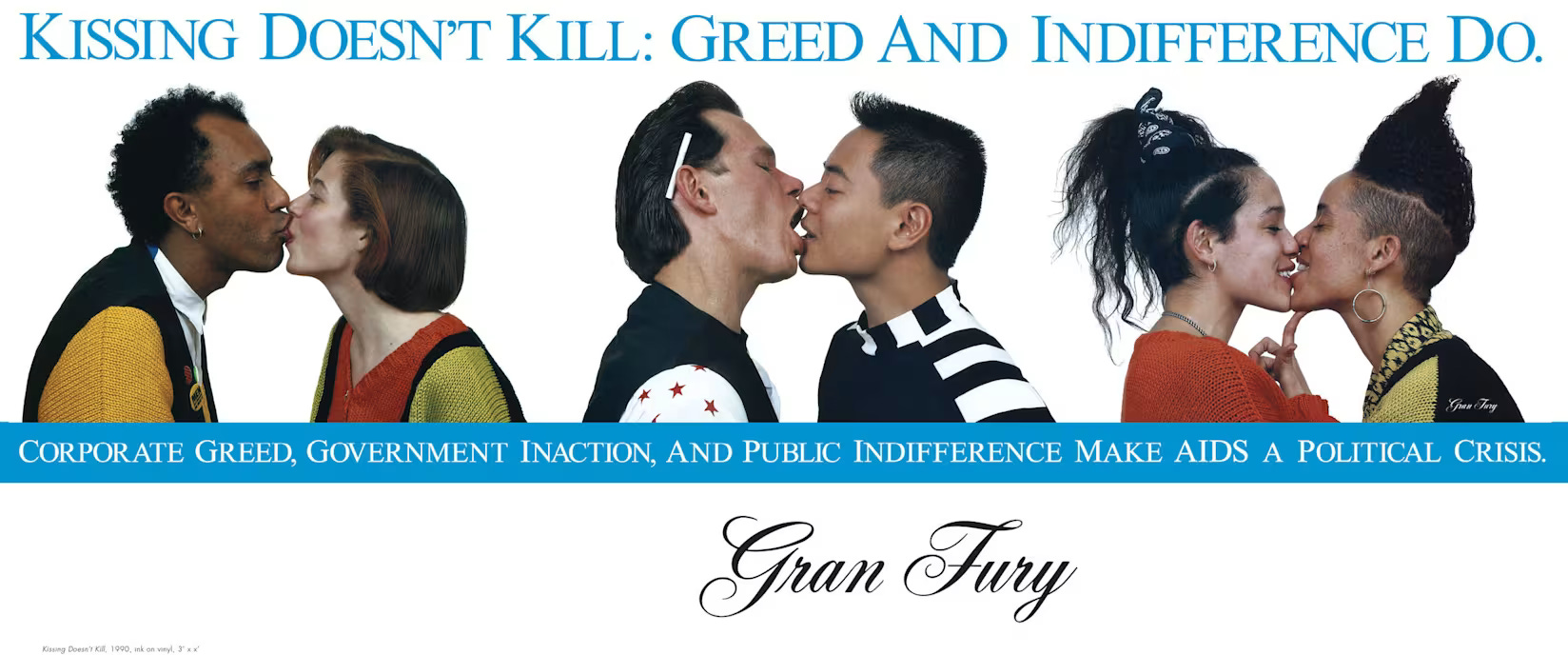
This trolley goes by, and every couple except the lesbian couple had been spray-painted out with white paint. I thought, some lesbian graffiti artist appropriated this. I was so thrilled by it, and I took a picture of it. And then there’s the graffiti in Chicago, where there was an alderman so offended by the same-sex couples kissing, and also by the mixed-race couple — the heterosexual couple is mixed-race — that they organized a graffiti campaign where they painted it out with black paint.
Both of those juxtapositions — the whiteout and the blackout — of this one work… And the work was censored by amfAR, the American Foundation for AIDS Research, when we originally proposed it. It had the tagline: “Kissing Doesn’t Kill: Greed and Indifference Do.” The three couples kissing, and the tagline: “Corporate greed, public indifference, and government inaction make AIDS a political crisis.” We were really happy with it. When we went to propose the final work to Art Against AIDS on the Road, they said, “No, you can’t say ‘corporate greed,’ because we’re seeking pharmaceutical company money — we’re amfAR.” So I wanted to walk, but Mark Simpson, who was also at the meeting — I was a hothead, I said we’re not doing this — Mark interrupted me and said, “Actually, we need to discuss this as a collective.” So we discussed it as a collective, and several people noted that there had never been images of same-sex couples kissing in America — there hadn’t even been a same-sex kiss on television.
JM: And what year is this, late eighties?
AF: So, ACT UP formed 1987, Gran Fury formed 1988. This poster project was designed in the summer but didn’t hit the streets until the end of ’88, into ’89.
JM: So having huge poster advertisements with kissing queer couples, kissing was radical.
AF: It seemed important to other members of the collective, and I wasn’t about to block it. Many years later, I did a talk, and somebody came up to me afterward and said that when they were growing up, they saw that poster, and it saved their life. So I realized: A, I’m not always right, and B, images have power, and you can’t always determine or imagine what that power is. But it’s my personal feeling that no form of intervention is irrelevant — all of it has meaning. You can’t know what the meaning is, or control what the meaning is, in late-stage capitalism — but not articulating your agency is a one-way street to nowhere. That’s how I feel about activism in general, and communicating in public spaces.
JM: Can I ask, Gran Fury was the artist collective in ACT UP. Why was the decision made to sign the posters as Gran Fury at the bottom, and not just ACT UP?
AF: You’re asking questions that involve very long answers. It became obvious…so Gran Fury was formed as an open committee within ACT UP, and people would come and go, sometimes go away on vacation and not come back for a month, and someone would come to the next meeting and something the meeting before had decided would be thrown up in the air again. It became very obvious to us that we would have to close the committee at some point. Up until that point, we were going to the floor of ACT UP to request money for printing or production costs. So instead of going to the floor, it became cumbersome — you’d get to the floor and people would be like, “Oh, I don’t think that’s a good idea,” or “I don’t think we should support that,” and then the next week everyone would be into it. So we decided it was impossible for us to work as a collective unless we closed it as a collective. It was at that point we started signing as Gran Fury, and it became a closed committee.
JM: Because I would assume ACT UP would kind of want that branding, for lack of a better word.
AF: No, here’s the thing about the ADT prop associated with ACT UP: it’s come to define the way we think about the AIDS historiography. There were people in ACT UP who worked at video stores, there were caterers, writers, nurses in hospitals, people who didn’t work at all, artists, writers, people in the sciences — but most people had no experience making visual work. They basically thought the posters rained down from the sky. Larry Kramer had no idea who made what, or what the differences were, or why anything was made. So I think the relationship between ACT UP and the visual art prop that’s come to represent it is so skewed by scholars and journalists and academics and activists — the people who write the history of activism — who have inserted a certain level of meaning-making that didn’t exist on the floor of ACT UP, which was an organism, at best.
JM: And going back to Silence = Death, you said you put it on pins, eventually made shirts, did posters. It’s become a symbol of ACT UP, and frankly, before I read your book, I just thought ACT UP created that phrase. I didn’t know it was created beforehand, that you guys brought it to them and pushed that phrasing, Silence = Death, into the public consciousness through the repetition of the posters, the shirts, the buttons. When did you start to see it take on a life of its own?
AF: Well, I was…people were dying in hospital hallways, so I was more concerned with the activist work and pushing for change that would save people’s lives than with what you’re asking about. No one in Gran Fury had even seen the “Four Questions” poster, which happened after Gran Fury officially folded. It was a splinter group made up of several members, and nobody had kept any posters. I was the only one who had, in that flat file, multiple copies of Silence = Death, AIDSGATE, all the Gran Fury work, the Lesbian Avengers work, like “Boys with Arms Akimbo.” I did not believe in history. I thought history was bullshit. And I’m not a pack rat, I mean, you can see the apartment is full, but this is an entire life’s worth of work.
JM: What do you mean, you do not believe in history?
AF: I think I came to believe — and I don’t believe in the art world either — I’ve come to believe in the corruption of historiography, the teaching of history. Even as a child, I was aware that whole things were being written out of what I was told. So it’s not that I don’t believe in history — I don’t believe that late-stage American capitalism understands the meaning of history, or copes with the ramifications of history. That’s what I mean by “it’s bullshit.” What I’m saying is late-stage American capitalism is bullshit. So I think it’s noteworthy that no one in any of the art collectives I was involved with kept anything. We did not make it to become fetish objects for study over decades. We made it to save people’s lives, and if something didn’t work, we’d be like, well, that didn’t work — let’s try this instead.
JM: You mentioned the Four Questions. Was that the final poster?
AF: It was the last poster, but there were two other projects we did after that.

JM: I want to read those questions. It was a white poster, and it says: “Do you resent people with AIDS? Do you trust HIV negatives? Have you ever given up hope for a cure? When was the last time you cried?” Will you talk to me about that last question?
AF: So, if you notice on that poster, “Gran Fury” is tiny, because we were trying to indicate that this wasn’t really a Gran Fury poster — though it kind of was. The poster came about because of the dissolution of Gran Fury. There were people who didn’t want to continue working anymore, because they felt we weren’t being effective, that we were failing too much, that we’d lost our ability to actually do something productive. That also happened as ACT UP was — there was a schism in ACT UP between the Treatment and Data group and the ACT UP membership. That’s when TAG was formed. So there was this conversation in the activist community, after years of work and burnout, that was causing all kinds of rifts. One of the rifts was: should people who are not HIV positive be speaking for people who are HIV positive — which wasn’t a conversation anyone was having prior to all of these rifts.
Gran Fury didn’t dissolve because of that rift, but Mark Simpson, who took his life a few years after this, was not prepared to dissolve Gran Fury. So I had this idea — Mark Simpson was raised by fundamentalist Christians in Texas, the opposite of my upbringing as a New York Jew. But the circle of friends I traveled in had Passover, and Mark became very attached to the Passover celebration. I still celebrate Passover with my affinity group from ACT UP, because it’s a political holiday for us, not because I’m in any way a religious Jew — I was raised as an atheist, we never celebrated Passover. I didn’t celebrate Passover until ACT UP. But Mark knew Passover, and I knew Passover, and there are the Four Questions in Passover — why is this night different, why do we lean on the table — I can’t remember all the questions in the Haggadah, but it seemed like a pretty good matrix to discuss the schism between HIV positive and HIV negative, which is what those first two questions are about.
“Do you trust people who are HIV negative? Do you resent people with AIDS?” There were younger people who resented people my age, because we had lived in a world prior to AIDS and had been able to have unsafe sex and it wasn’t a death sentence — which, up until the protease inhibitors, AIDS was. So there were all kinds of questions about resentment and blame and misgivings and burnout — those two questions address that.
JM: What’s the third question?
AF: “Have you given up hope for a cure?” The Treatment and Data group — one of my big complaints was it became very clear that a curative might be possible, but to actually call for a cure was not scientifically feasible. So there was a whole range of treatment activists moving away from that conversation, but I was not prepared to give up that ground. So that’s what that question is.
JM: And that was pointed back at ACT UP?
AF: At AIDS activists, at treatment activists, at political activists, at the community. This was a creed. And the last question — “When was the last time you cried?” — when we were crafting these lines of text, it was becoming apparent within certain circles in ACT UP that burnout was overpowering our efficacy. So that was a throw-down to the question of: okay, we’re strong, we’re moving ahead, we’re fighting for everyone’s life, we’re concerned with our ethics and efficacy — but when was the last time you cried? We were so sick of burying people, and of course everyone cried all the time. But the question seemed like a political one to ask.
JM: This kind of political art nowadays exists primarily online. What do you think we lose when it’s not in a public space like that?
AF: Well, online is a public space — it’s a different public space, but—
JM: It’s more temporary, right?
AF: Potentially. There’s nothing as threatening as seeing something in a physical space in front of you. I had this idea of dyeing every fountain in Washington, DC red — found a naval dye marker and did logistics checks. We couldn’t figure out how to make it work. But the idea being: you can write letters, you can do demonstrations, you can shake your fists at a building with offices in it, but if every fountain in your city is blood-red, it changes the way you think.
JM: And you can’t avoid it.
AF: It’s unavoidable. Physical spaces have meaning because they have a relationship to corporeality that art in a museum does not have. A political poster in a museum doesn’t have that — a poster on the street does. You have to walk up to it. And Silence = Death — one of the ways it functioned, with the pink triangle, on the bus, on the speeding car — the subtext was for the queer community; that was the political organizing text. You have to walk up to it to read it, and because it’s in a smaller point size, you’re walking up to it — you’re already activating your body. It’s performative. And scrolling does not have that same relationship. But having an archive in your pocket is still an efficacious means of communication — it’s not irrelevant. It might be temporal, but so is a poster — posters didn’t last forever, they were washed out in the rain. So I think the idea that physical spaces are more permanent, and less ephemeral than digital spaces, is a misapprehension of meaning-making. It’s the content that moves politics, not the delivery device — whether it’s a broadsheet, a poster, a pocket computer, a laptop, it’s irrelevant. It’s what it says that has meaning.
JM: And so online, it is no less effective. It’s just a different means?
AF: I don’t think it’s less effective. It’s another thing. If you were to say it’s ineffective, you’re basically saying an entire generation of digital natives has no correlation to their politics. And that’s not true. That can’t be true. It’s just not true.
JM: Yeah. To my mind, people will disagree with me, I can’t think of an easy comparison between ACT UP and any other group that’s come since. The size, and how effective ACT UP was, is completely shocking. Why do you think we haven’t seen a group like them since?
AF: I have to disagree with you completely.
JM: Tell me.
AF: Occupy Wall Street, Black Lives Matter — there, and internationally, there are many examples. What happened in Minneapolis — I don’t know that it disappeared, but what happened in Minneapolis has impacted America, has changed the way America thinks about what’s happening politically.
JM: I guess I was thinking those are a shorter timeframe, and…
AF: Well, ACT UP still meets every week, but it stopped being ACT UP — probably 1993 — it stopped being that powerhouse. And I think, if you’re looking at Gran Fury as another case study — if you look at Gran Fury’s work product, almost everything Gran Fury did was designed within the first year of its existence, and is a reimagining of something that was tried, that didn’t quite work, or was retried or reevaluated — “Read My Lips” became “Kissing Doesn’t Kill.” If you think critically about it, the window of productivity of Gran Fury is much smaller even than the few years for which it’s known.
JM: I see. I’m thinking, frankly, about today, in 2026, what’s happening to the trans community in the United States is horrifying. Every day a new state passes a new law that shocks you, how cruel they’re able to be. The ACLU is fighting back in courts, different groups are trying different things, but there hasn’t been an applicable ACT UP response to those threats.
AF: Queer Art, the Queer Art Mentorship program, ongoing, I’ve been involved with them for five, six years — is heavily trans-inflected, performance and visual artists, people on the board, people who run it. I think there are many responses. There’s room for many responses. If what you’re saying is ACT UP was this gigantic monolith, that’s a misapprehension of what ACT UP was.
JM: But also, ACT UP was able to have policies changed, right…
AF: Yes.
JM: Yes. I’m looking for a group that’s able to, you know, monumentally improve trans lives in fifty states. I think we’re needing that.
AF: I think we are too. Yes, for sure.
JM: And I think what’s not comparable is that everyone in ACT UP, from what I understand, is…if you didn’t think you had HIV, you thought you were going to get it. Everyone felt like their lives were on the line. And unfortunately, the entire LGBTQ community does not feel like they have their lives on the line, and so the response has been more tepid. That’s my take.
AF: I think you’re right about it, but I think that also applies to gay rights. The way that capitalism functions — just because you’re granted some rights doesn’t mean they can’t be taken away, doesn’t mean it’s not an object or a system in flux. And the thing I always say about political activism is you don’t have to be everywhere all the time — if you need to step away, you put it down, and somebody else picks it up. That is the nature of activism and social change.
The thing about your statement, that ACT UP made concrete policy changes — the fact that it had that ability meant being invited into the system. That was also what neutralized ACT UP. So, yes, concrete things happened when treatment activists became involved in treatment protocols at the NIH and the FDA — it’s great that those things changed — but it also meant TAG spun off from ACT UP. So ACT UP lost its treatment action ability, because it was neutralized by a system that was inviting them in. Anyone who has ever been an activist in any cause would tell you that’s how capitalism functions — you become neutralized by being given a seat at the table.
I think the smiley-face part of ACT UP is: protests happened, drugs were approved, no one dies of AIDS anymore — which is, of course, untrue. So that smiley-face version of it ignores the more radical questions involved. That doesn’t speak to the trans question, and I don’t know the answer to that question. It’s a good one, though.
JM: Well, I don’t think anybody does — if we had an answer, we wouldn’t have the question. I’m not the only one — people like to look to history for an example of how to confront the terrors of today, and there aren’t a lot of perfectly applicable examples. So that’s why I appreciate you engaging in the conversation. I do want to ask — when did you finally get tested for HIV?
AF: So, my longtime partner, who I’m no longer with and haven’t been with for a long time, was in my affinity group — his boyfriend had just taken his life, and I met this person, who will remain unnamed, within a few months after that. He was ten years younger than I was — he was in his twenties, I was in my early thirties. We assumed, because I had buried Don, that I was HIV positive and he was HIV negative. Once we realized we were kind of thinking we’d be a couple, it would be irresponsible not to be tested. So that would’ve been 1989.
JM: And were you surprised by the result?
AF: We both were. He was HIV positive, and I was HIV negative. It was shocking.
JM: And that’s just luck, right? It’s a dumb question…
AF: Yes, absolutely. Don and I — we didn’t have safe sex, safe sex didn’t exist. But I think, to go back to the question of why aren’t people activists for trans rights — I was an HIV-negative person fighting for HIV-positive people and people with AIDS. I think it’s possible, if your consciousness is raised, to see it as your fight. And of course, any fight for autonomy and human rights is all of our fights. Because I’m older, and I lecture and talk a lot, I deal with a lot of younger people who feel sheepish about talking about AIDS because they weren’t even born when this happened. I tend to say to them: I wasn’t in the Holocaust either — I was born after it happened, but it is my story. AIDS is everyone’s story. It’s your story. You do not have to have lived through it for it to be your story — you have to care about it for it to be your story. And that’s true for race, for gender, for trans questions, for all of it.
I think we ask the wrong question when we think you have to be fully invested for something to be effective. I don’t think that’s true — look at all the white people in the Black Lives Matter marches. There’s enough proof of that, that we shouldn’t subject ourselves to these sort of imaginary dividing lines. I hate to use that phrase, because “division” is a triteness of 21st-century America — but the dividing lines are imaginary. They’re of our own construction, cultural constructions, but we also reify them by not participating in other people’s struggles. The struggle for humanity — is this the only struggle?
Click here to listen to the full interview on the LGBTQ&A podcast.
LGBTQ&A features interviews with the most interesting lesbian, gay, bisexual, transgender, and queer people in the world. Hosted and produced by Jeffrey Masters. @jeffmasters1
Most newsletters are annoying.
This isn’t one of them.
Subscribe and never miss an update.

You must be logged in to post a comment.